What happens when you spend nearly a decade exploring Vancouver Island with a camera never very far away?
You end up with a lot more than photographs.
Since JUSTGO began in 2017, thousands of pieces of media have accumulated around the places, people, road trips, campervan adventures, businesses, beaches, campgrounds, communities and completely unplanned moments encountered along the way.
Professional video.
Traveller photos.
Social posts.
Interviews.
Drone footage.
Roadside discoveries.
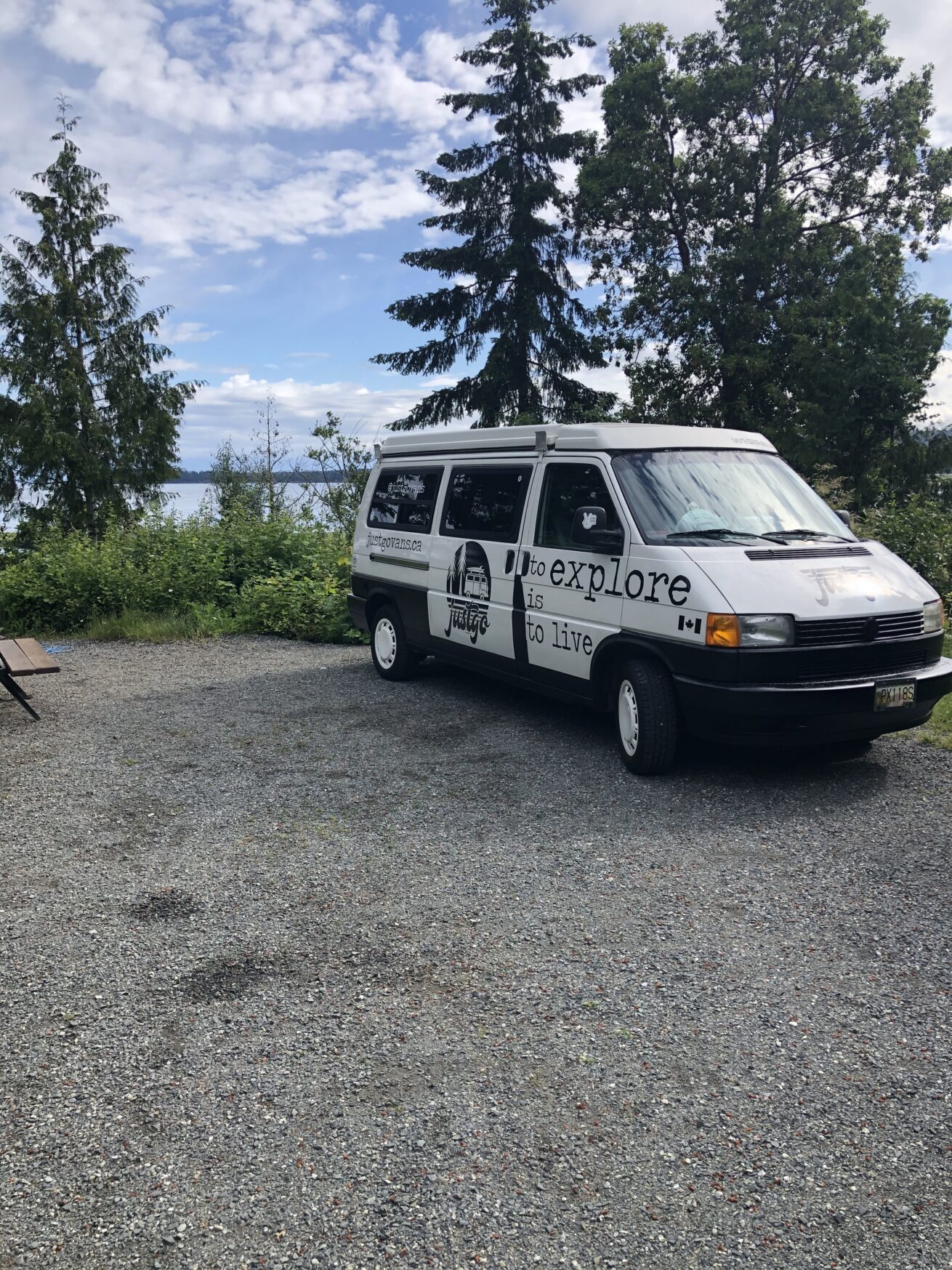
Westfalias parked in ridiculous places.
Beaches we meant to visit.
Beaches we didn’t.
People we met once.
People who became part of the story.
Nine years later, the JUSTGO archive has grown to more than 5,000 pieces of original and community media connected to Vancouver Island travel and exploration.
Individually, they’re moments.
Together, they’re something much bigger.
They’re a living record of what it looks like to discover Vancouver Island.
It Started With a Campervan
JUSTGO began in 2017 with a spontaneous decision and a vintage Volkswagen Westfalia.
The idea was simple enough:
Get people out there.
Explore Vancouver Island.
See what happens.
But for JUSTGO founder Lisa Ostrikoff, whose background was already rooted in television news, video and digital media through BizBOXTV®, there was another instinct operating almost automatically.
Document it.
The first campervans provided a reason to move through Vancouver Island.
The camera came along for the ride.
Beaches became stories.
Campgrounds became stories.
Road trips became stories.
People became stories.
Even the things that went completely wrong occasionally became stories.
And every trip created another opportunity to see Vancouver Island from somewhere new.
“JUSTGO was never envisioned as simply a campervan rental company. I came from media, I still work in media systems ~ I knew what happened around the experience was ultimately bigger than the rental itself. Vancouver Island gave us an endless supply of stories, at first the campervans got us out there, and media allowed those stories to travel far beyond the road.”
— Lisa Ostrikoff, JUSTGO + BizBOXTV founder
One Trip Became Thousands of Stories
A road trip is temporary.
Media isn’t.
You might spend ten minutes standing on a beach.
A photograph of that moment can still be discovered years later.
A traveller might take a campervan somewhere for four days.
The photos and videos created during those four days can continue circulating long after the vehicle comes home.
Someone watches a JUSTGO video.
They discover a place.
They save it.
They send it to someone.
Six months later, they’re standing there themselves.
And maybe they take another photograph.
Experience → Media → Discovery → Experience.
That loop has been operating around JUSTGO since the beginning.
Thousands of Pieces of Media Changes What You’re Actually Building
At some point, an archive stops being a collection of content.
It becomes infrastructure.
Thousands of pieces of media means thousands of individual signals documenting Vancouver Island through different seasons, locations, experiences and perspectives.
There are summer road trips and winter beaches.
Rainstorms and sunsets.
Campgrounds and ferry rides.
Forests and cities.
Vintage campervans and modern travel experiences.
Local businesses.
Wildlife.
People.
Places that became famous.
Places that still barely appear in search.
And thousands of ordinary moments that collectively say something extraordinary:
This is what Vancouver Island actually looks like when you go exploring it.
That’s different from creating a tourism campaign about Vancouver Island.
JUSTGO has been accumulating the story one experience at a time.
The Archive Was Built in the Real World
That distinction matters more now than it did in 2017.
Artificial intelligence can create an extraordinary image of almost anything.
Ask for a cinematic Vancouver Island beach at sunset and a machine can generate one in seconds.
But an original photograph carries a different signal.
Someone was actually there.
The road existed.
The weather happened.
The ocean looked like that.
The campervan was parked there.
The person took the trip.
The moment occurred.
As generated media becomes increasingly abundant, documented reality may become increasingly interesting.
“AI makes it possible to generate almost anything we can imagine. I think that makes the things we actually experienced more valuable, not less. There is something powerful about being able to say: this wasn’t generated. Somebody was actually here.”
— Lisa Ostrikoff
JUSTGO’s archive doesn’t represent an imagined Vancouver Island.
It represents thousands of encounters with the real one.
Vancouver Island Never Runs Out of Content
There is a practical reason the archive became so large.
Vancouver Island is an absurdly good media engine.
Drive an hour and the environment can change.
Drive another hour and it changes again.
Pacific beaches.
Rainforest.
Mountains.
Lakes.
Waterfalls.
Small communities.
Cities.
Working harbours.
Surf towns.
Campgrounds.
Wildlife.
Ferries.
Food.
People doing interesting things in interesting places.
Then the weather changes and the same location becomes a completely different story.
JUSTGO didn’t need to manufacture an endless stream of content ideas.
The Island kept supplying them.
The job was to notice.
The Socialgenic Factor
Looking back at thousands of pieces of JUSTGO media reveals another pattern.
People didn’t need to be constantly asked to create content.
They wanted to.
Travellers photographed the campervans.
They photographed their campsites.
They photographed where they woke up.
They sent photos from beaches, forests and campgrounds.
They tagged JUSTGO.
They shared their road trips.
They documented moments because the experience itself gave them a reason to reach for the camera.
That’s what we now call the socialgenic factor.
A socialgenic experience naturally creates the impulse to capture and share it.
Not because someone handed you a content brief.
Because something happened that felt worth remembering.
“The moment somebody instinctively reaches for their phone is fascinating to me. Something happened before the content existed. Attention was captured. An emotion was created. The person decided that moment was worth preserving.”
— Lisa Ostrikoff
The media is the evidence.
The reaction happened first.
From Audience to JUSTGO #FAM
Some of the most interesting media in the archive wasn’t created by JUSTGO at all.
It came back from the road.
Travellers.
Friends.
Families.
Creators.
Local businesses.
People who encountered JUSTGO.
People who explored somewhere because of something they saw.
Each person noticed something different.
That matters.
A professional media team can document Vancouver Island beautifully.
Thousands of people experiencing it from different perspectives can document something else entirely.
They create a collective view.
That’s why JUSTGO increasingly thinks about this material as Community Media, rather than simply user-generated content.
UGC describes where an individual asset came from.
Community Media describes what happens when those individual perspectives accumulate.
Different people. Different adventures. One Island.
Welcome to the JUSTGO #FAM.
Nine Years Changes the Perspective
When you’re creating media every day, it’s easy to think in individual posts.
What’s going up today?
What’s the next video?
What’s the next article?
What’s the next trip?
But zoom out nine years and the individual posts become almost irrelevant.
You begin seeing the system.
One photograph connects to another.
One destination leads to another.
One traveller’s adventure becomes someone else’s inspiration.
A campervan video introduces someone to Vancouver Island.
A Vancouver Island article introduces someone to a campground.
A campground leads to a community.
A community introduces them to a business.
A business leads to another story.
Discovery compounds.
And suddenly the archive isn’t simply showing where JUSTGO has been.
It’s helping determine where someone goes next.
The Audience Was Always Bigger Than the Rental
Not everyone who encountered JUSTGO needed to rent a campervan.
Some people simply wanted to watch.
Some wanted travel ideas.
Some wanted to discover Vancouver Island.
Some lived here already.
Some were planning their first trip.
Some followed because they loved the old Westfalias.
Some found a beach.
Some found a campground.
Some found a local business.
Some just liked watching where the road went next.
That distinction became increasingly important.
The physical travel experience could happen once.
Media could allow that experience to travel indefinitely.
“A trip has a beginning and an end. Media doesn’t necessarily have one. Something we captured years ago can introduce someone to Vancouver Island today. That’s when you realize the story can become much bigger than the original experience.”
— Lisa Ostrikoff
From Campervan Brand to Travel + Media Network
Nine years later, that original instinct has become much easier to see.
JUSTGO is still connected to the road-trip experiences that started it.
But the larger opportunity exists around discovery.
WATCH
Original Vancouver Island travel videos, adventures, people and places.
EXPLORE
Road trips, camping, communities, beaches, destinations and things worth discovering.
SOCIAL
Real-time Vancouver Island discovery distributed through the JUSTGO social ecosystem.
COMMUNITY
Thousands of moments contributed by travellers and the wider JUSTGO #FAM.
EXPERIENCE
Ways to move from seeing Vancouver Island to actually experiencing it.
Together, those layers form the growing JUSTGO Media Network.
Not simply media about a product.
Media about a place.
The Most Valuable Thing in the Archive Might Be Time
You can buy cameras.
You can launch a website.
You can generate hundreds of social posts.
You can create a new travel brand tomorrow.
There’s one thing that’s harder to manufacture:
Nine years ago.
You can’t recreate the first road trips today.
You can’t manufacture a genuine 2017 photograph in 2026.
You can’t retroactively document all the places, people and experiences encountered along the way.
Time creates context.
And context creates meaning.
The early Westfalia photographs matter partly because they were early.
The traveller photos matter because they represent actual experiences.
The progression matters because it shows change.
The imperfect media matters too.
Together, it creates something no single campaign could produce:
history.
And We’re Still Exploring
More than 5,000 pieces of media sounds like a lot.
Until you consider how much of Vancouver Island remains undiscovered.
Another road.
Another beach.
Another campground.
Another business.
Another person with an interesting story.
Another community we’ve driven through but haven’t properly explored.
Another part of the Island we’ve never seen.
Another photograph somebody hasn’t taken yet.
That’s perhaps the most interesting thing about looking backward through nine years of JUSTGO.
The archive doesn’t feel finished.
It feels like the beginning of something much larger.
Because after thousands of photographs, videos, stories and adventures, the original question remains exactly the same:
What else is out there?
There’s really only one way to find out.
JUSTGO.